Strategy

When the Shopper Is a Robot: What Agentic Commerce Means for Email
Agentic commerce could hit $500B by 2030. When AI agents complete the purchase, email becomes the last direct line brands have to their customers.

Executive Summary:
Agentic commerce is no longer hypothetical. Bain & Company projects it could reach $300–$500 billion by 2030, around 15–25% of US e-commerce.
When an AI agent checks out, brands will likely receive little more info than an email address. Channels like email will become the primary surface for a direct human relationship, first-party data and loyalty.
Human-guided AI is the counterweight. Backstroke's approach, where marketers set direction and AI does the heavy lifting, keeps humans in command of the channel a brand actually owns.
Can Robots Do My Shopping?
Wharton professor Kartik Hosanagar recently described shopping in ChatGPT's Atlas browser. Within a single chat, he was looking at a number of products without ever visiting a retailer's website. There was no search results page, browsing or doomscrolling on his end. He simply asked a question. AI then suggested a product.
Boiled down, that's a type of agentic commerce. A newer type of shopping experience is when a purchase is initiated, influenced or completed by AI agents. It’s distinct from journeys that simply use AI for search or discovery:
AI assistants suggest products while a human still decides and buys.
Shopping agents research, compare and—in fully autonomous modes—complete the purchase themselves. The agent chooses your purchase. You don’t.
With shopping experiences becoming automated, the power of email amplifies. Because when a shopping agent makes the purchase, email becomes the most direct line a brand has to its customer.
Agentic Commerce Isn't Hypothetical
Bain's forecast projects agentic commerce could account for up to $500 billion in U.S. sales by 2030. That’s 15–25% of total U.S. e-commerce. Recent consumer data shows why:
30–45% of U.S. consumers already use generative AI for product research.
17% plan to start holiday shopping directly on tools like ChatGPT or Perplexity.
In fact, 52% of Millennials plan to use these tools for holiday shopping.
AI already influenced roughly $3 billion in American Black Friday sales last year, even as most consumers remained hesitant about letting an agent complete a purchase on its own.
Last holiday season was the first true one to surface agentic commerce data. Salesforce found AI and agents influenced about 20% of global online holiday orders, and that AI-referred traffic converted 9x better than social traffic. Adobe found AI-driven traffic to retail sites surged 693% during the holiday season, and conversion flipped from 38% worse in March 2025 to 42% better by March of this year.

From "Search and Browse" to "Shop for Me"
Discovery is shifting away from traditional search and into conversational AI. People no longer rely on Google alone to find answers, as they’re increasingly asking ChatGPT and Gemini their questions.
Zero-click search now accounts for roughly 65% of consumer searches, up nearly 15 points in one year. At the most recent CommerceNext conference, Hosanagar delivered a keynote address, citing a 34.5% drop in organic CTRs when an AI overview appears, alongside roughly 1,200% growth in AI referral traffic in seven months.
AI agents are taking on more of the shopping journey, screening products and recommending options before a customer even lands on a brand site. Without a deliberate strategy, brands risk becoming little more than back-end fulfillment for AI models that steer demand and mediate the customer relationship.
Being visible to agents is now table stakes, but visibility is not the same as owning the relationship. That’s the gap email needs to fill.
What Retail's Leaders Are Saying
Agentic commerce was the defining conversation at CommerceNext's 2026 Growth Show. Its keynote "How AI Search and Agentic Commerce Are Reshaping Retail" detailed three misconceptions brands make:
assuming there's always a human on the other end of a transaction,
assuming crawlability is sufficient,
and treating AI as just another channel.
The reframe? AI is a new class of customer. Even beyond sprinting to accommodate AI shoppers, retailers also need to focus on a whole new slew of challenges—protecting their brand, product discovery and customer loyalty when AI does the browsing.
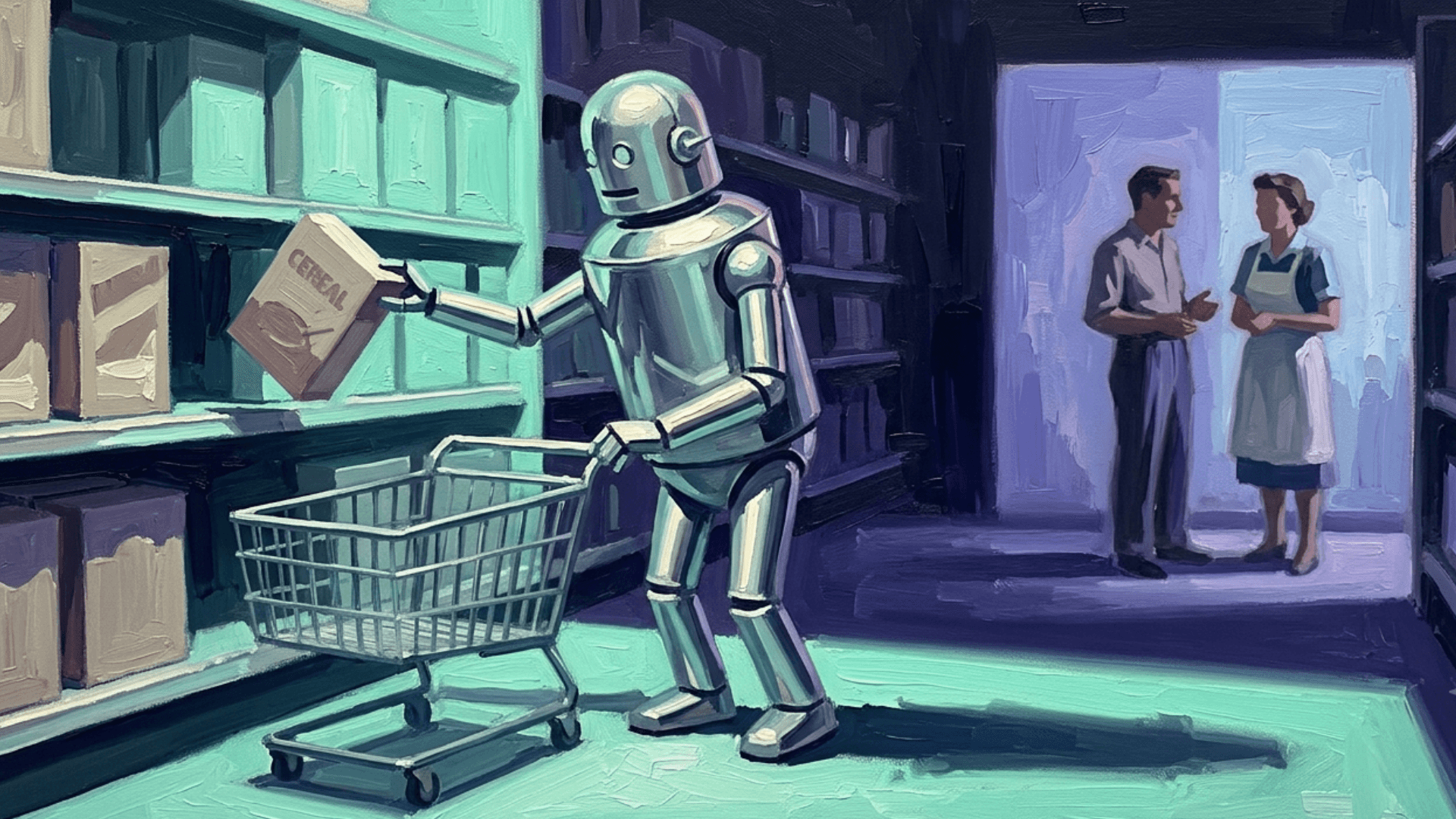
When the Agent Buys, Email Owns the Relationship
When an AI agent completes a transaction, the brand may come away with little more than an email address. Therefore, owned channels like SMS and email become the primary mechanisms for building relationships.
The gap between recognizing this and acting on it is wide. An HFS Research survey of senior commerce and marketing leaders found 78% believe first-party data and a direct consumer relationship will matter more in an agent-mediated world. Yet only 37% have a plan to act on that instinct. That 41-point gap is a massively important finding, as the same survey found 76% of marketers worry that consumers could trust their AI agent more than the brand itself.
Email is uniquely positioned to close that gap. It gives brands a direct line to customers and access to information they’ve chosen to share. Unlike data that lives on someone else’s platform, email data is something the brand actually owns.
It also helps turn one-time buyers into people who feel like they connect with a brand. As search and discovery move into AI tools, email and SMS become even more important, not less. Email is where brands will handle the follow-up after a purchase—like welcome emails, reminders to restock and related product suggestions—which helps turn a single sale into a long-term customer relationship. Consumers want that relationship to feel connected, personalized and human.

Human-Guided AI: The Counterweight to Autonomous Checkout
Agentic commerce automates the transaction, but it can’t automate a relationship. That's the space Backstroke is built for.
With our model, marketers define direction and intent, and AI handles the heavy lifting at scale. While third-party shopping agents optimize the buy side for price and availability, Backstroke applies AI to strengthen the brand’s personalized email communications. Backstroke's data, drawn from a proprietary dataset spanning more than 10,000+ B2C brands, and our customers see roughly 31% more revenue per send.
In a world where AI can choose for the shopper, the brands that win are the ones that remain worth choosing in the channel they control. Today’s challenge is for ecommerce retailers to build their engine before the storefront changes underneath them.
So what do you need to do?
Today: Audit your first-party data capture. Make email/SMS sign-up frictionless. Confirm agent-referred orders feed a unified customer profile.
Next quarter: Optimize your post-purchase flows that are triggered by order events, regardless of where the purchase happened.
This year: Modernize loyalty into genuine membership, and measure repeat-purchase rate and lifetime value, instead of just opens and clicks.
No one knows exactly how fast or how big agentic commerce will get. In fact, the estimates vary, and early results are mixed, but the overall trend is clear: AI is going to play a bigger role in how people shop.
That's exactly why email matters so much. If you build a strong email program today, you're protected either way—whether AI agents end up doing 15% of shopping or 50% of it, you'll still own a direct line to your customers that no AI platform can take from you.

