Product Updates

Introducing Backstroke’s L5 Agentic Engine
Backstroke’s new L5 Agentic Engine builds fully dynamic, on-brand email campaigns from a simple brief—unlocking flexible layouts, faster production, and data-driven performance.

Designer-level flexibility. Agentic-level efficiency. Data Science-level performance. A massive step forward in how email gets made.

Over the past year, foundational AI models have advanced in ways that meaningfully expand the complexity of work that AI marketing software can handle. Tasks that once required rigid templates, fixed layouts and brittle workflows can now be managed through multi-step reasoning, structured planning and dynamic generation. As these models matured, it became clear that relying on predetermined HTML frameworks (eg: email templates) was no longer the most reliable path to creating unique, on-brand and effective email campaigns that also kept up with the ever-changing needs of eCommerce marketers.
For some time, Backstroke has been living with a gap between the experience customers saw on the surface and the constraints underneath. Our interface was, and is, simple and approachable. Yet, the underlying system was tied to a hybrid architecture built around templates and rules that reflected the limits of earlier foundational models. It worked for many teams, but not for all of them, especially as Backstroke's generative messaging products gained interest from larger and more sophisticated marketing teams. These brands require flexibility and adaptiveness in all things from campaign planning, to segmentation, to email generation and variation.
In Q3 2025 the AI industry took a big jump forward. The foundational models arriving around this time (eg: OpenAI’s GPT-5, Anthropic’s Claude Opus 4.1 and Claude Sonnet 4.5) offered capabilities we had not seen before. Capabilities like dependable multi-step reasoning, stronger layout awareness and far better control over long-context generation.
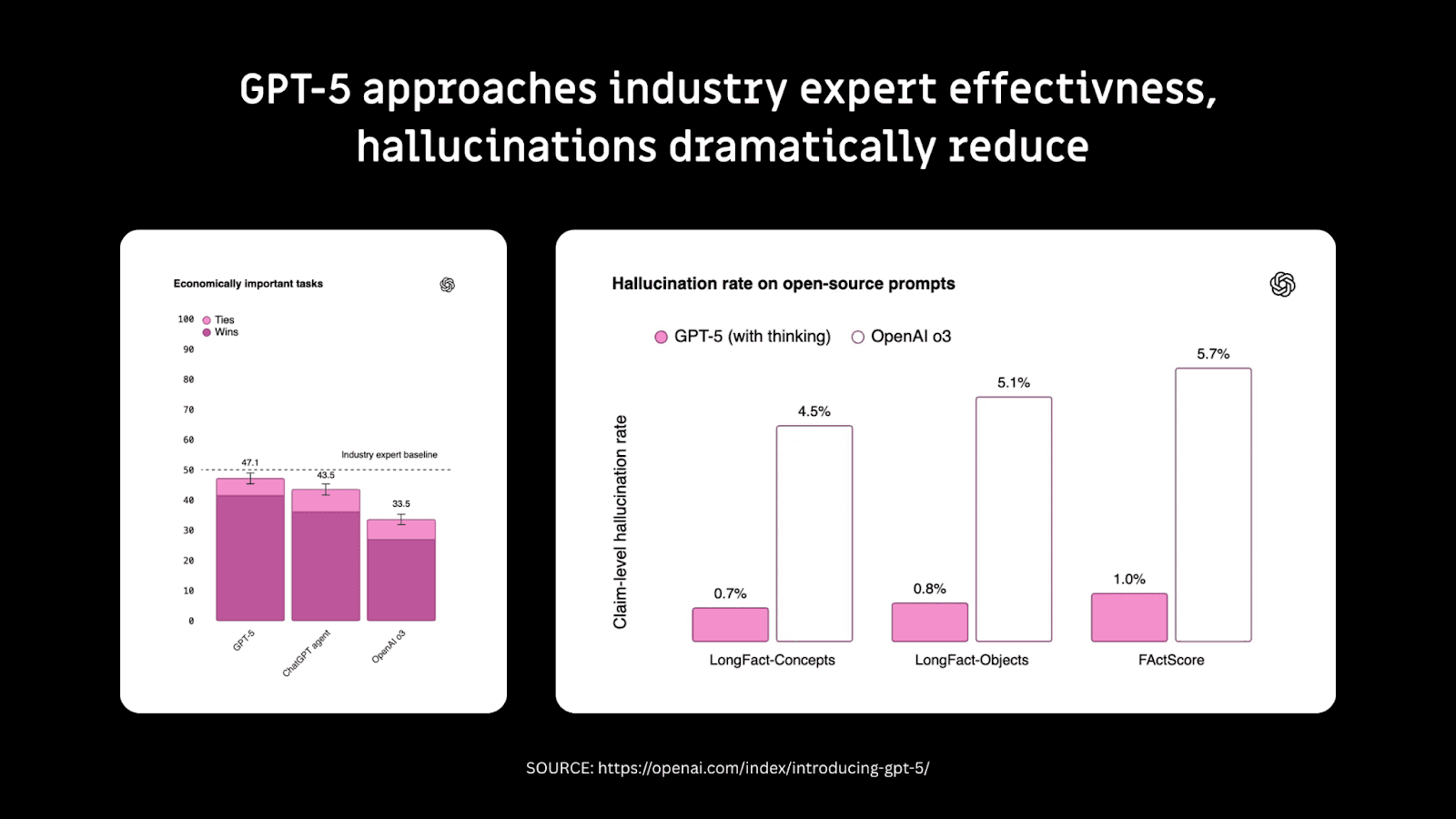
Parallel improvements in Model Context Protocols (MCPs) and agentic workflow design by Backstroke’s AI team meant these capabilities could be orchestrated in a stable, effective, and secure way. And it was more possible than ever to tap the billions of email and SMS datapoints within Backstrokes proprietary datasets.
In layman’s terms, email campaigns could be generated in totality from a simple creative brief, and the email outputs could morph to the needs and goals of that specific campaign.
This is in contrast to previous iterations of Backstroke, where campaigns were shoehorned into pre-defined templates with limited ability to be flexible on the fly.
This is the future we’ve always imagined at Backstroke. And it’s why we are so incredibly excited to introduce our L5 Agentic Engine which is now the default artificial intelligence mechanism within our platform. The new drivetrain reflects our most common customer requests, resolves longstanding rigidity in the system and creates space for a class of performance that wasn’t possible before.
The appetizer has been cleared. The main course is here. Now, we eat.
A New Foundation for Email Creation
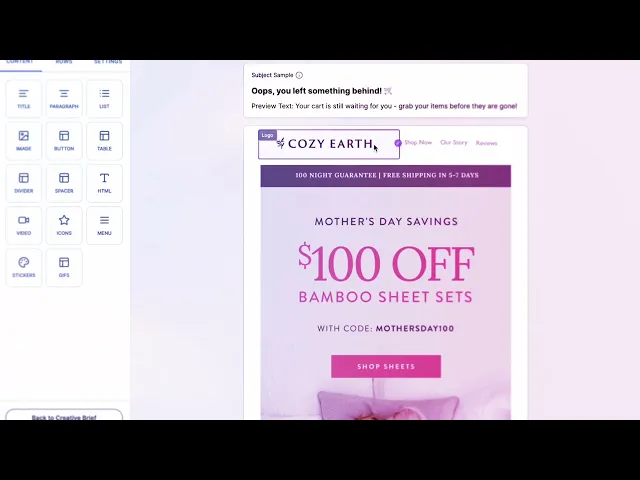
The L5 system is designed around agentic workflows, rather than predefined templates. Instead of dropping content into a static structure, the engine plans and constructs layouts dynamically based on the brand, the content selected, the intent of the message and sometimes reference HTML.
This shift enables several important capabilities:
1) Flexible, brand-aligned layout formation
The engine starts by forming a structural plan. It decides how many modules an email needs, how products should be arranged, where emphasis should go and how copy should be distributed. Layouts adapt to the shape and goals of the message, rather than forcing the message into a preset framework.
2) Multi-pass reasoning and refinement
Email creation now happens through a series of coordinated steps. The agent interprets campaigns requests, like a creative brief, collections page and/or a set of product description pages. Other agents form a plan, draft an email structure, create and populate content and refine tone and layout to match the brand. This produces consistent results across a wider range of inputs, edge cases and brand preferences. You can read more about our modular system architecture and its implications here.
3) Embedded image generation through AI Content Studio
Backstroke has always offered AI Content Studio (AICS) as a standalone product. Marketers at brands like PSD and Cabana Life use AICS to generate photoshoot quality content to leverage in email campaigns. The new L5 Agentic Engine allows marketers to tap AICS simultaneously during the construction of the campaigns. This means asset requests can be made within the creative brief itself and Backstroke agents will call AICS and inject brand new imagery into the email.
4) A more resilient editing experience
Late-stage changes no longer break the system. Adjusting a headline or promotion triggers the engine to re-evaluate the structure so the final layout still feels coherent. This makes the tool feel closer to working with a flexible design partner, rather than a set of locked components. Backstroke is also rolling out expanded in-app editing capabilities for times when that little human touch is a must to take a campaign from great to perfect.
5) Production-ready reliability and security
The new engine was built for the realities of modern email marketing. Campaigns move quickly. Inputs vary. Creative, merchandising and brand requirements shift throughout the process. The L5 engine means Backstroke is designed to support these dynamics in a secure, SCO2-ready environment.
Read more about our security upgrades in our November launch announcement.
[Case Study] Forward-Thinking Cozy Earth Proves Agentic Workflow in the Wild
Cozy Earth, a luxury DTC brand known for its elevated creative standards and high horsepower promotional calendar, was among the first to use the new engine. Their team saw significantly faster email production cycles and more adaptable layouts without compromising the brand’s refined visual identity. Routine campaigns became easier to generate, revise and finalize.
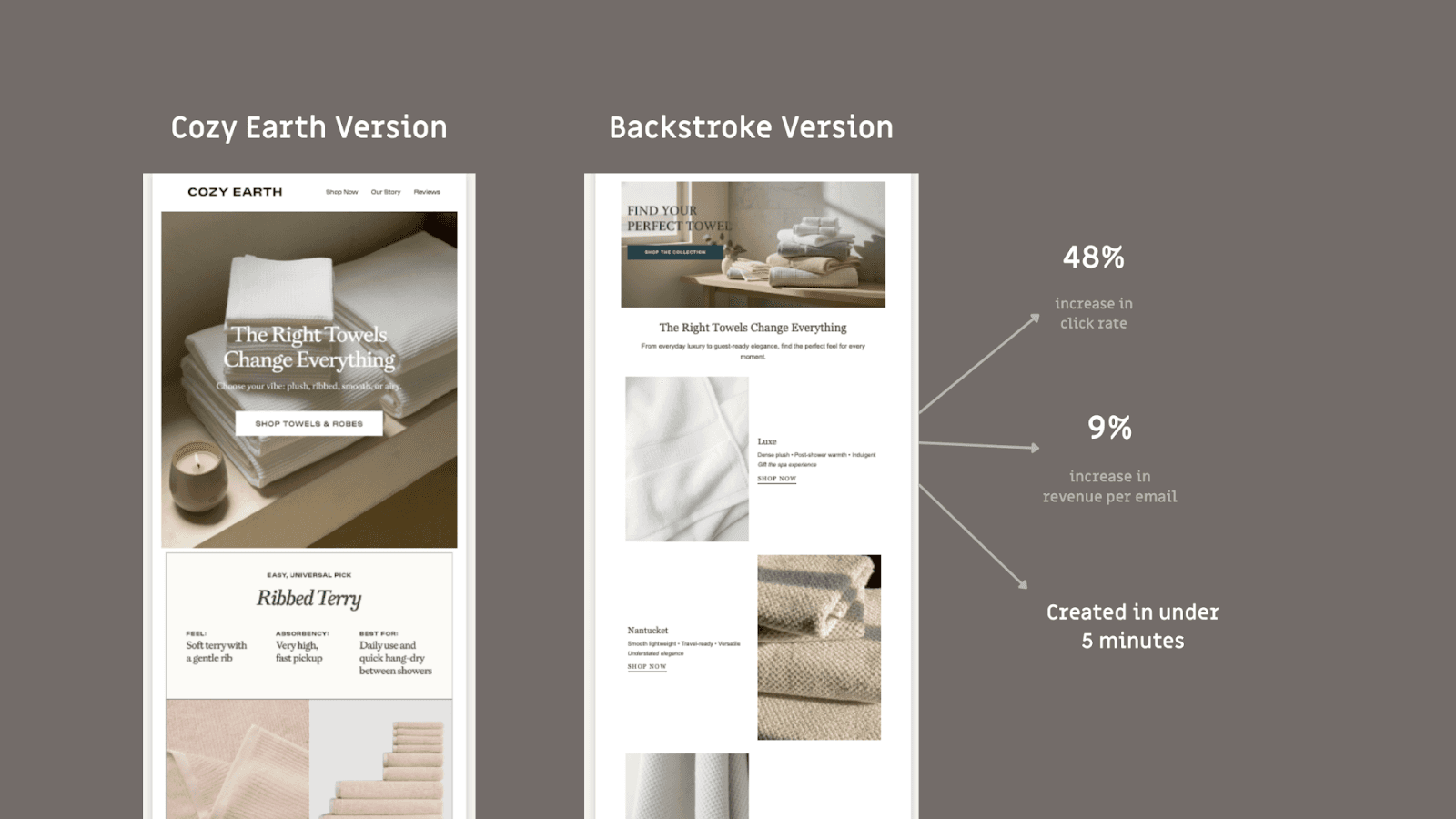
Not only were campaigns on-brand and easy to generate, the campaign performance spiked as well. In a 50/50 split test, the Backstroke variant saw a 13% higher conversion rate and a 9% higher revenue per email.
You can read their full case study here.
Why the Timing Matters
The rollout of this new engine aligns with a shift in how consumers view AI-generated marketing. According to the Backstroke Q4 2025 Consumer Survey, 61% of consumers now say they are likely to engage with AI-generated marketing content. Just two quarters ago, that figure was 25%.
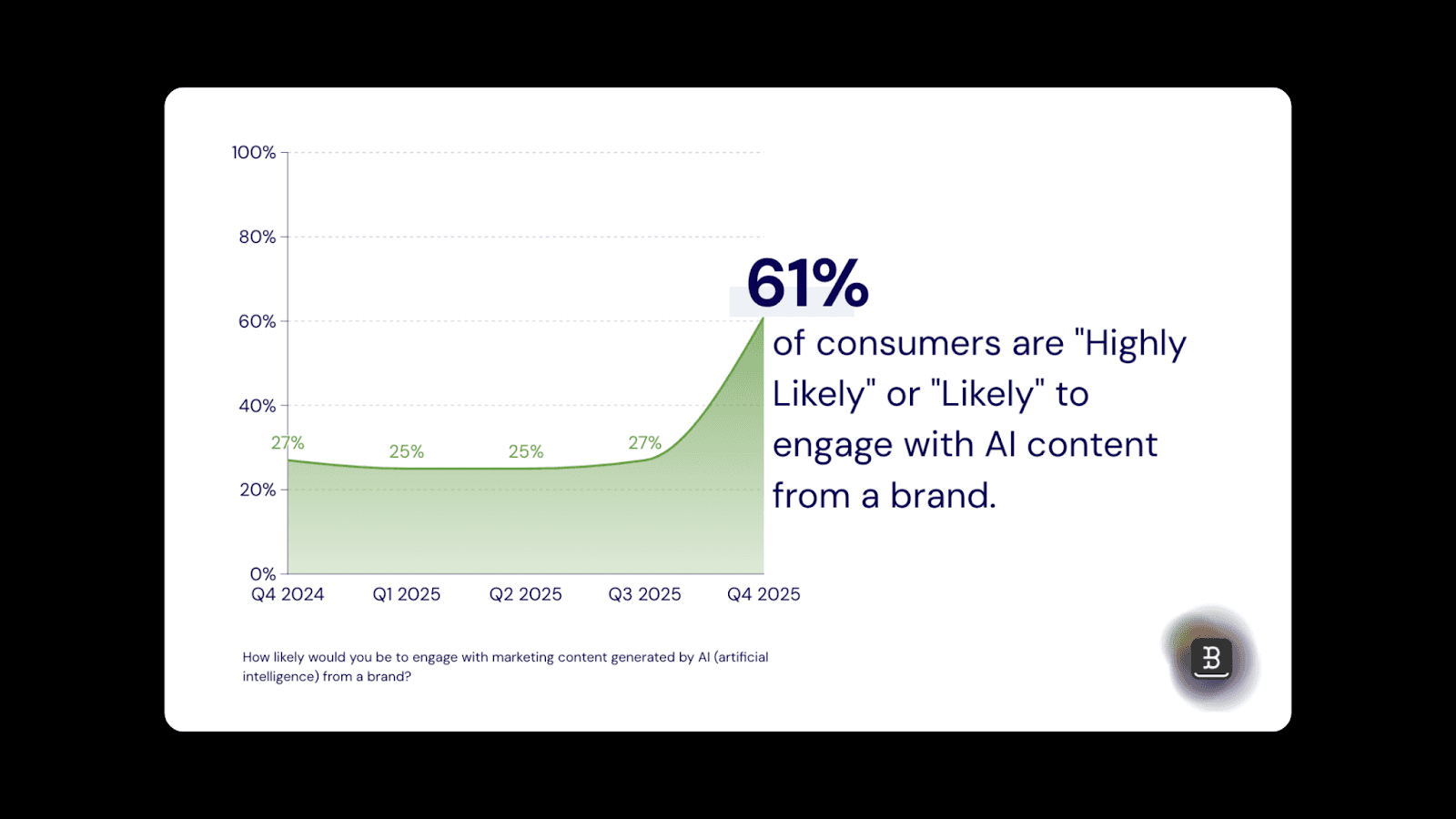
The survey also shows that positive sentiment toward brands using AI has grown significantly. For many consumers, the quality and relevance of the content matter more than whether it was created with AI. Attention follows clarity and usefulness, not the method of production.
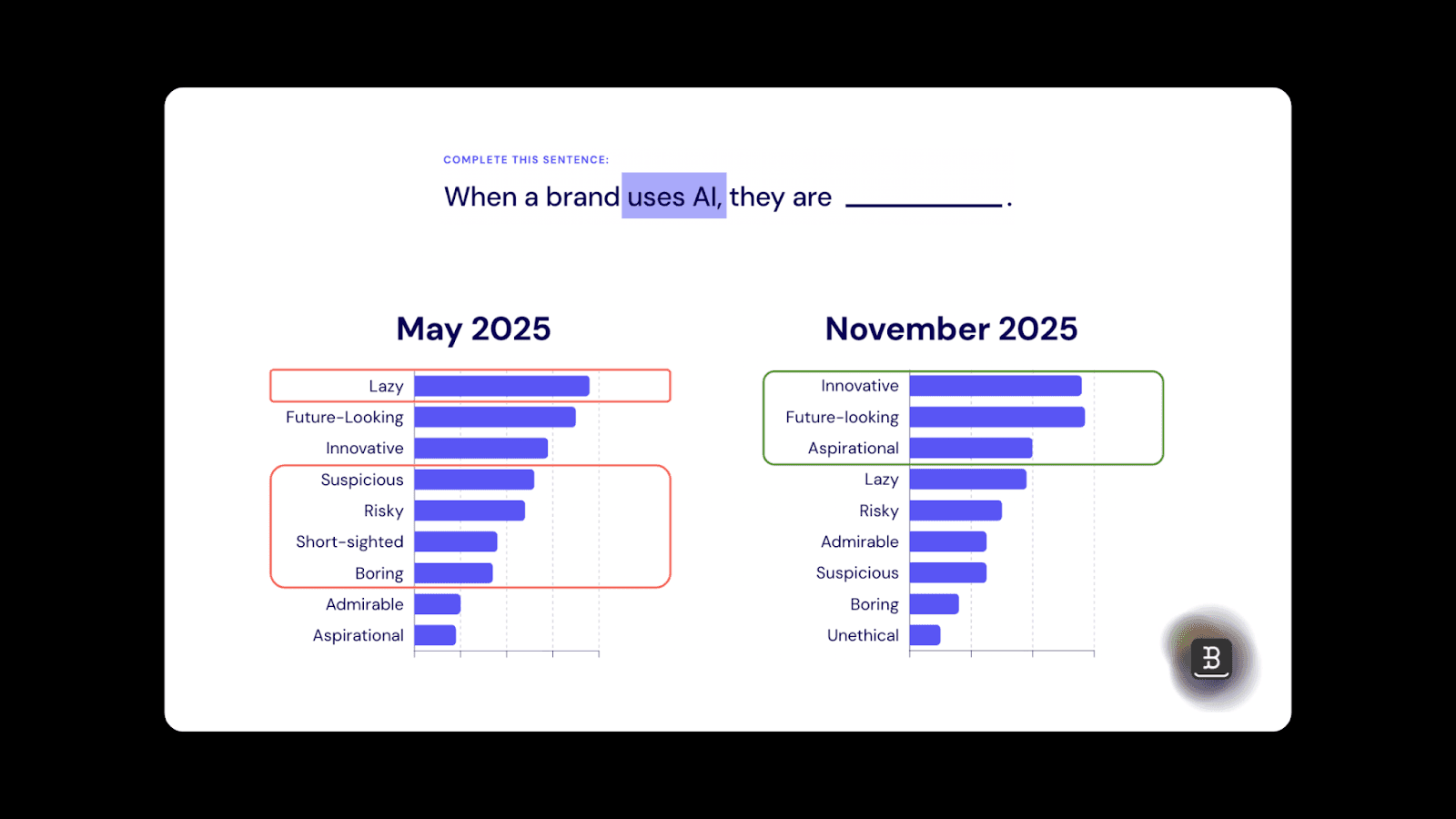
While consumer and media negativity towards AI does still exist, it’s very clear the sentiment towards AI-enabled marketing is shifting in a big way. This cultural shift removes a barrier that once made teams hesitant to adopt AI-assisted workflows. Marketers now have both the capability and the audience support to work in a more intelligent, adaptive way.
These and more are buoyed by the fact that most consumers can’t consistently delineate between AI generated content and human generated content in the first place. And as foundational models and software systems alike continue to improve, the already blurred line gets even blurrier.
Now More than Ever, We Lean into Our Humanity
Despite our work building AI messaging systems of the future, our team at Backstroke has never believed more strongly in the power of humans. Our technology approach aims to augment repetitive and rote tasks with AI systems so that people can do what people do best—create, think, adapt, collaborate, problem solve and grow.
It is with this spirit of community and connection that we announce the return of our user conference, Longaxis, in April of 2026.
Longaxis 2025, our inaugural conference, attracted more than 100 eCommerce and DTC marketers from brands like Helix Sleep, Nutrafol, Steve Madden, Magic Spoon, Veronica Beard, Favorite Daughter, Seed and UrbanStems.
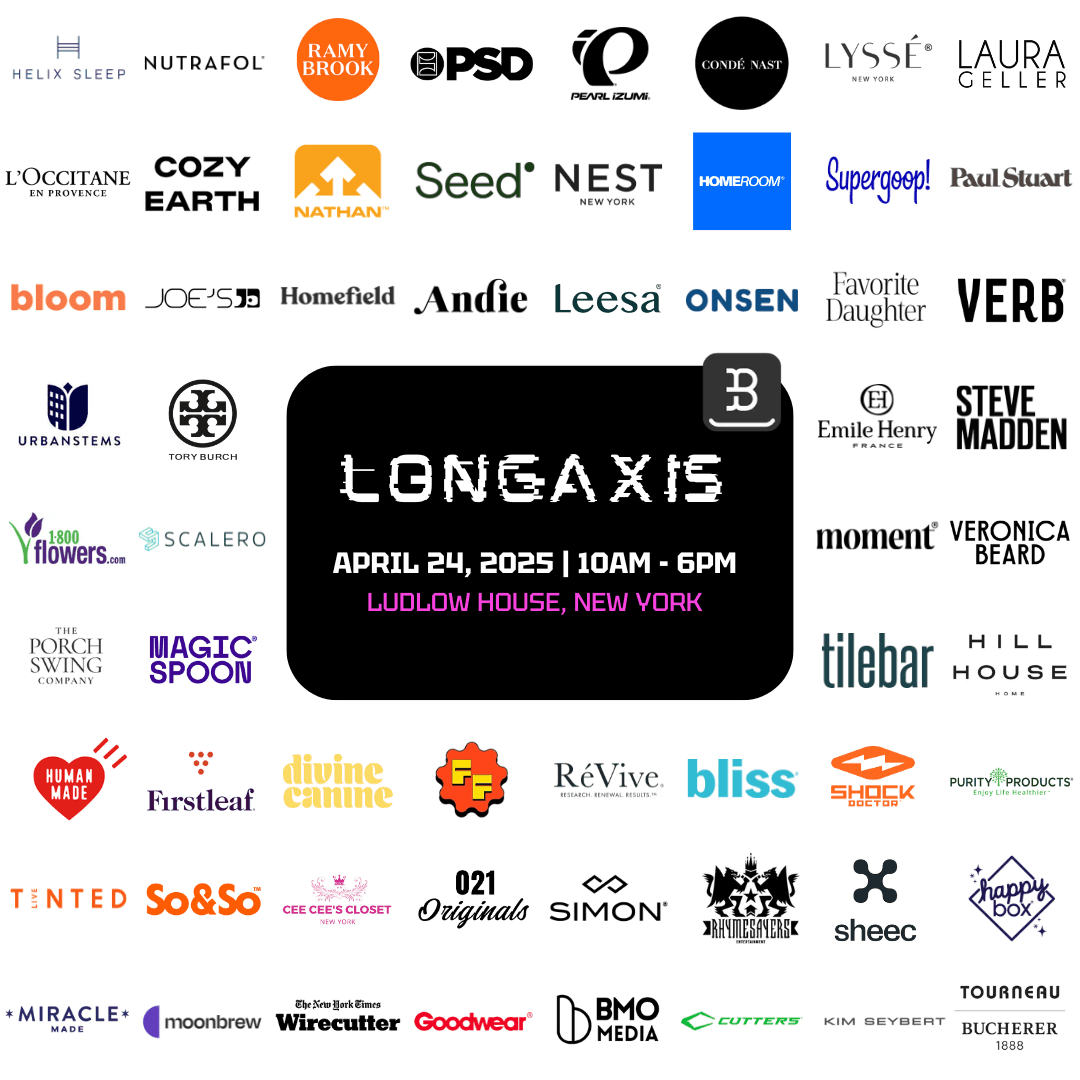
(Longaxis 2025 attending brands)
We can’t wait to bring back the marketers, operators and leaders who are shaping this next era of marketing. Early registration, which qualifies you for a free All Access conference pass, goes live today. All Longaxis registrations are by invite or application only.
Longaxis 2026 will be at Maxwell Social in Tribeca on April 16 from 10:00 AM – 6:00 PM
This year’s program will focus on real-world applications of agentic marketing, evolving consumer expectations, the intersection of creativity and automation. It’ll be weird, fun, different and we promise you’ll make at least one new friend.
Additional details will be shared soon. In the meantime, you can apply to attend here.
A Step Forward for Email Creation
Email remains one of the highest-leverage channels available to digital brands, yet the creation process has often been heavier and more manual than necessary. Our aim with this new engine is to offer software that adapts to how marketers work and supports the pace and complexity of modern campaigns.
We’re excited to share it with you and to see what teams build with it. For a comprehensive demo we recommend joining this webinar on December 17, or contacting us via the Demo Form on our website.
Thanks for following along.

