Guides
Can AI Actually Stay On‑Brand? The 2026 Guide to AI Brand Management
Anyone can use AI, but brands relying on it need to ensure its outputs are up to snuff. Here's our guide to AI brand management and how ecommerce marketers can train AI tools to create exactly what they need.

The promise of generative AI is alluring. It can spin up creative in seconds, test dozens of variations and personalize messages at scale. Yet seasoned marketers still cringe at the thought of lifeless, generic content and AI slop.
Today’s core tension is: AI promises speed, but at what cost to quality content and true brand identity?
In marketing, quality always wins and a sloppy one‑size‑fits‑none hero image can tank an otherwise brilliant campaign.
The good news? AI can absolutely stay on‑brand . . . if you train it properly.
Without high‑quality data, clear guidelines and human-guided feedback loops, generative AI simply spits out whatever average internet patterns you’ve fed it.
”Garbage in, garbage out” is an idiom you’ve heard all too often by this point. You know what it means and that, sure, it’s true. But let’s actually take it a step further. Here, we’ll break down why some tools struggle with achieving brand-quality outputs, why some don’t and how to train your AI email tools to accurately portray your brand.
Why Do So Many AI Tools Struggle With Brand Consistency?
The most well-known AI models are trained on broad internet data. That makes them fantastic at producing something, but not your thing.
For copywriting, generic LLMs can easily default to spewing bland, off‑brand fluff. Designers see the same issue with images (in fact, our Head of Design has written a whole manifesto on it). Generically trained image generators churn out visuals that scream “AI‑generated,” rather than aligning with your aesthetic.
The cure for all this? Document your voice, set clear guardrails and make human review part of your creative approval process.
How Do the Best AI Email Tools Safeguard Your Brand?
Backstroke was created to fix email marketing bottlenecks and create on-brand content that connects with your subscribers. Our latest Hero Lab release addresses the AI visual issues that your creative team knows too well.
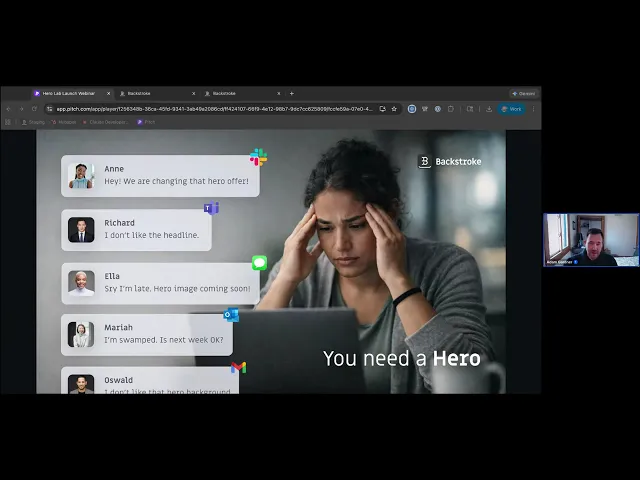
Here’s how this new feature works. Imagine it’s Thursday afternoon. Your copy and offers are locked in. Your campaign launches Monday. The only thing missing? A hero image. You ping your designer and they’re slammed. You open Canva and two hours later you have something you don’t love. Leadership wants changes. Suddenly it’s Sunday night and your email is going live in twelve hours . . . Or you hope it does. Sound familiar?
AI email tools like Backstroke let marketers generate fully-branded campaigns, and Hero Lab generates branded hero images in about 60 seconds.
So how do these tools work? You supply a creative brief, including info on copy, the call‑to‑action, product photos and visual direction. The system applies brand styles it's been trained on, uses your direction and generates image options you can tweak or regenerate.
The Benefits of Tools Like Hero Lab
Speed: Rapid generation means you’re no longer waiting on designers. Marketers can produce hero images on demand and iterate quickly.
On‑brand output: It doesn’t produce generic AI slop. Hero Lab uses your brand kit to reflect your fonts, colors and aesthetic. The output looks like something you would be proud to send to subscribers.
Predictive heroes: Coming soon, Hero Lab will tailor visuals to each audience segment. A win‑back customer will see a different hero than a high‑intent repeat buyer. That’s where Backstroke’s secret sauce—our proprietary data—comes in.
Good Data In → Good Creative Out
AI doesn’t invent new, brilliant marketing campaigns. It has to be instructed what to produce. If your customer records are messy, your conversion events mis‑labelled and your KPIs inconsistent, you can’t teach models the lessons they need to succeed.
AI thrives on clean, quality data. It’s ultimately a reflection of your inputs. To deliver personalized experiences that feel human, you need to master tracking the following:
First‑party behavioral data: Track page views, search queries, purchases and returns. These signals drive predictive triggers, giving you a thorough understanding of what different audience segments are likely to do next.
Brand guidelines: Document tone, banned words and preferred language as references for any copywriting models.
Historical performance metrics: Let your AI know which campaigns and images drove your best results. Performance labels help models learn what “good” looks like for your brand.
High‑quality product images: Feed systems professional imagery. Advanced AI can preserve product details, lighting and reflections so generated images are indistinguishable from studio shots.
Clear KPIs: Tell the system what success means for your email. Is it clicks, purchases or sign‑ups? AI needs an objective to optimize for.
Clear, high‑quality inputs allow AI to learn your nuances and elevate your email creative.
How to Train AI on Brand‑Specific Voices
Now that we’ve covered the basics of what type of data to share with your AI tools, let’s cover how to teach AI to sound like your brand. Here are a few best practices:
Document your voice: Identify your tone, banned phrases and preferred language. A conversational brand avoids stuffy words like “furthermore,” while a more technical brand may prioritize precision. Put together a style guide to share with your LLM and team.
Feed AI examples: Platforms like Custom GPTs, Gemini Gems or Backstrokt allow you to upload style guides and sample content, so their models learn your voice. Be sure to provide thorough examples. Brand voice‑training platforms suggest at least 15,000 words of long‑form content or about 15 samples for short form.
Review and refine: AI can’t and shouldn’t replace human editors. Always read its outputs, adjust prompts and add more details to your prompts when models drift.
Account for multi‑channel nuance: Train separate GPTs for email, LinkedIn, Instagram and even specific spokespeople. A brand can have multiple “voices” depending on the channel.
The result? Your AI tools will write like a creative director, and not an intern.
How to Train AI on Brand‑Specific Visuals
Teaching AI to create on‑brand imagery requires similar rigor. Here are a few best practices:
Create a brand kit: Upload your color palettes, logos, fonts and multiple image styles into a brand kit. This allows AI to apply these styles by default.
Provide reference images & tag styles: Upload at least 15–20 reference images that capture your desired aesthetics. Make note of attributes like lighting, color and composition. This trains the model to understand what “on‑brand” looks like.
Ensure visual consistency: Once your models are trained, using identical or similar prompts will yield coherent visuals.
Preserve product details: Advanced AI can generate great product angles, lighting and reflections, making images look like studio shots.
Use governance & templates: Centralized prompts and templates ensure teams reuse approved designs and maintain consistency.
Your design team still sets the standards, but think of AI like a new, faster execution layer of your process.
Why Is Backstroke’s Dataset So Valuable?
Unlike many aforementioned tools, Backstroke isn’t generating content and images based on generalized data. Its models are trained on a proprietary dataset built from 12,000+ ecommerce brands.
This cross‑brand dataset helps us uncover patterns in what types of copy, CTAs, layouts and images drive engagement for different subscriber segments and verticals. Backstroke draws on millions of real campaigns to understand what works for win‑back customers, high‑intent shoppers and one‑time buyers.
The Future Is Full of Predictive, Segment‑Aware Creative
As segmentation becomes more granular and content more dynamic, brand‑safe AI is a differentiator. Only when AI is powered by clean data, thorough training and specific guardrails can it stay on-brand, though.
Backstroke’s tools, like the new Hero Lab, marry speed, brand fidelity and predictive intelligence to solve these issues at scale. By feeding the system high‑quality data and custom brand standards, Backstroke generates beautiful hero images and email campaigns faster than ever, all of which are optimized to connect with your customers.
Want to see it in action? Let’s chat about how the next wave of email marketing will be smarter, more personalized and unmistakably you.