Strategy

What to Do When Subscribers Run Their Own Inbox Agents
Your subscribers are building their own inbox agents. And you have zero visibility into their rules. Here's how to still land in the primary inbox when the gatekeeper is a black box you'll never see inside.

The easier stories to talk about are how Apple Intelligence summarizes your subject lines and Gemini reshuffles the inbox. The harder story to comprehend and address is happening on the subscriber's side.
Backstroke co-founder Egan Montgomery posted about it recently. He set up an AI assistant to read and organize his personal inbox, following a list of custom rules he wrote.
Whitelist ten brands: Brooks, Asics, Buck Mason, Quince, Tyner Pond Farm, Whole Foods, Lowe's, Costco, Ticketmaster. Nothing from them gets archived without his say so.
Anything offering over 20% off gets promoted straight to his primary inbox.
Transactional emails get filed to "Updates," with the redundant messages archived and urgent ones starred.
While consumers like this are now on the bleeding edge of AI use, we can use Egan as an example of what everyone else will be doing in a few months. That's a subscriber habit shift worth paying attention to, as it’ll only escalate. By 202, 50% of people in advanced economies are expected to use AI personal assistants for daily tasks, including product discovery and inbox management.
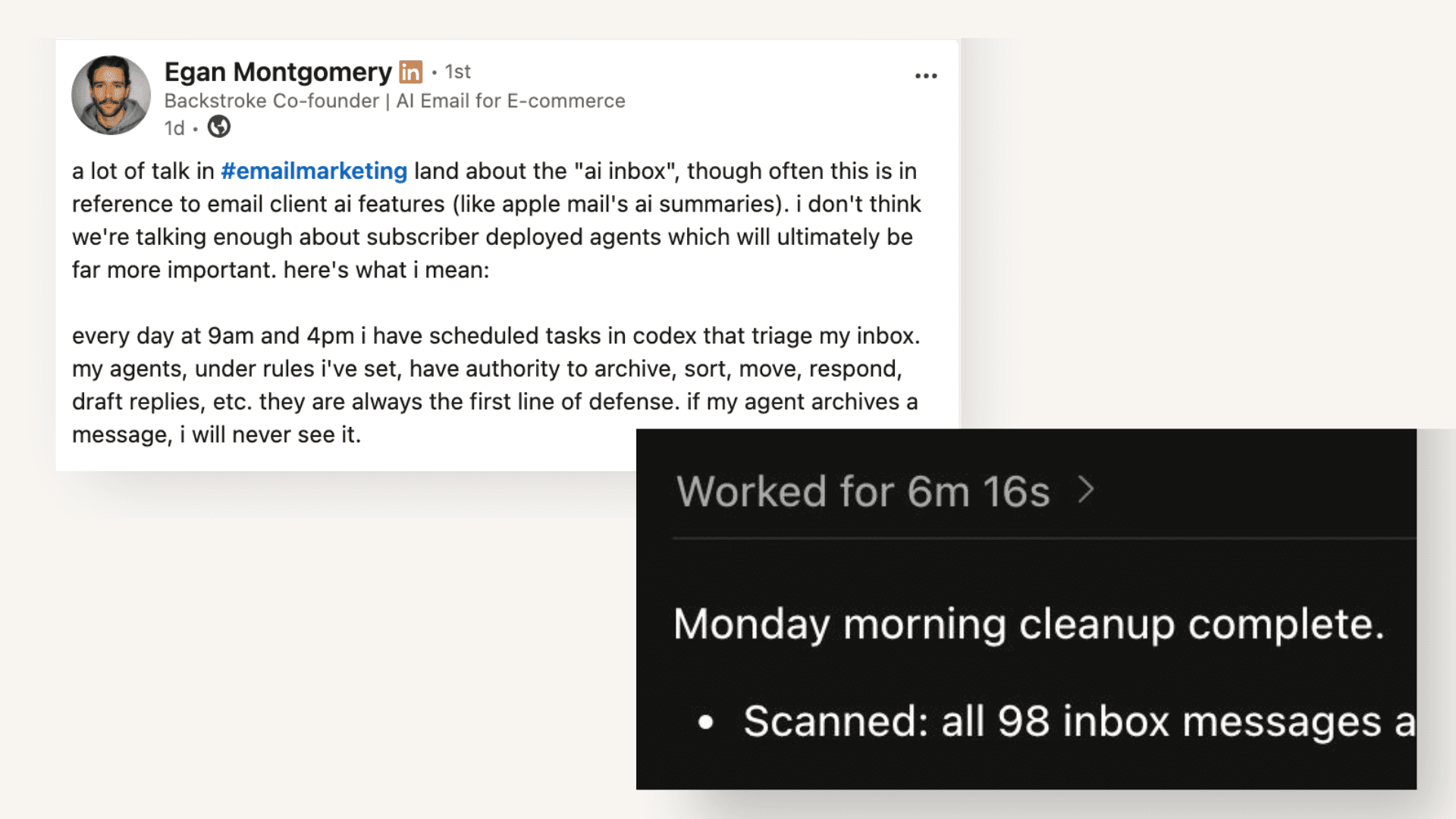
Subscribers are getting smarter alongside inboxes, as consumers deploy their own agents, with their own rules that are completely invisible to you.
A Third Gatekeeper Has Entered the Game
For most of email marketing’s history, you’ve had to clear two hurdles to reach the inbox. First, deliverability factors like authentication, reputation and spam filters check whether you even get through the door. Second, provider-side ranking determines if you're worth showing, once you’re in.
Now, a third gatekeeper is here to play. It's individualized. It's invisible to email marketers. And it varies subscriber to subscriber, because each person's agent runs on rules only they wrote. The same email that gets promoted to one person's primary inbox can get archived in another, based on preferences you'll never see and can't test against.
We’re starting to see software brands produce AI assistants that organize your inbox and promote the most relevant messages tuned to your tastes:
Superhuman's shipped last October. Its Auto Archive feature automatically files away marketing emails, cold pitches and social notifications before they ever reach the inbox..
Shortwave lets users write plain-English rules like archiving generic marketing blasts.
Inbox Zero, an open-source tool, shipped a cold-email blocker and lets people describe in plain language how their AI should organize their messages.
And DIY builds, like Egan’s use of Codex to directly organize his inbox, are popping up in tech coverage and how-to write-ups often enough to indicate that they’re no novelty.
They’re introducing a new metric that’s starting to matter. This will look like an "agent action rate" that can indicate if your email got surfaced, acted on or clicked through, versus filed away and forgotten. No major ESP has formalized this metric yet, and we consider that an opportunity.
Earn the Whitelist Now
Earning a whitelist status doesn’t require gaming a black box. The tactics that earn you a spot on someone's personal whitelist are the same tactics that make you a better sender in general. A few things worth doing this quarter:
Get your authentication airtight. SPF, DKIM, DMARC and BIMI are required. Agents, like spam filters, treat unauthenticated senders as suspicious before they’ve read a word of your content. Fully authenticated senders see inbox placement rates of 95–98% and domains using all three protocols are 2.7X more likely to land in the inbox.
Exploit the opportunity gap. Despite the requirements, only 33% of top domains have valid DMARC records, meaning most domains still leave themselves vulnerable to being treated as suspicious. Around 39% of the top 1 million domains lack SPF, creating an immediate deliverability handicap before any content is read. For brands that lock down SPF, DKIM and DMARC now, you’re earning a trust signal that agents and inboxes use to fast-track your messages while competitors are still stuck at the gate.
Make your subject lines fun yet factual. Curiosity-gap subject lines that oversell the body may work on people, but AI agents are quick to flag the mismatch between what you promised and what you delivered. You can be honest and still offer quippy, stand-out, personalized subject lines. Just use the data you already have to inform what you deliver.
Front-load the value. Put the actual point of the email in the first 100–200 characters. If your message can't be reduced to a clean two-sentence summary, that's a content problem you need to solve before sending.
Respect the 60/40 rule. Emails should be roughly 60% HTML text to 40% images.
Actually write, because if it matters, it has to live in real text. Apple Intelligence ignores images, alt text and even emojis when it scans an email. Anything buried in a JPEG or GIF is practically invisible to AI. If your email is one giant image, its summary is likely to describe your footer text. And that's before ranking even gets involved. With 45% of emails opened with images off by default and spam filters flagging image-heavy mail, sending an all-image email is like putting a message in a bottle and then tossing it into outer space.
Stop mailing the disengaged. Every send to someone who never opens or clicks teaches both the algorithm and personal agents that your messages are skippable. Trim your list. Protect your reputation with the segment that still wants you.
Lifecycle and behavioral relevance is what earns trust from machines and humans. That's the whole idea behind our latest Hero Gen 2.5 update. Instead of averaging one "winner" across your entire list, it runs every hero image through a per-cohort competition, so each group of subscribers gets the creative that actually fits their interests and behaviors.
Be worthy of whitelisting. Egan chose to whitelist ten brands because they'd earned it. They offered consistent value and sent nothing he regretted opening. That's the bar. Be the brand a subscriber actively protects from their inbox agent from axing.
The Agent and Human Want the Same Thing
The instinct that used to separate "what plays well with spam filters" from "what your subscribers actually want" is melding into one thing. An agent trained to act like a thoughtful, slightly skeptical reader is automating good taste. Optimize for genuine relevance and value, and you're optimizing for both audiences at once.
This is exactly the kind of shift Backstroke's platform is built for. Marketers set the direction and intent, and AI agents handle email execution, tuned toward the personalization that both inboxes and humans are starting to demand.
The inbox is getting harder to reach, but just as importantly, it’s getting harder to deserve. Brands that act on these shifts now—before "agent visibility" becomes a standard line item in every ESP's reporting dashboard—will continue landing in the primary inbox because they deserve to.
Curious how to create an email program that both people and agents love? Book a Backstroke demo to get started.